Wednesday, November 25, 2009

Lazarus Bees

It was a little devastating and so unexpected.

I arrived at the yard around 4:00 on an overcast day with temperatures hovering around 9. I was checking on how the bees had fared with the winterized bee cozy installed and the sugar feeder.

First glance showed about 100 dead bees on the front stoop of Hive #2 (two bees on Hive #1). It was so very sad because most of these bees were carrying pollen. So they died on the stoop from cold and exposure. Their hive never received the pollen they worked so hard to collect. It was upsetting.

I can only presume that even though the day the cozies were installed was cool and it was near dark that there must have been at least 100 bees still out in the field foraging. By the time they returned it would have been near dark and cold. And then they would not have recognized the new looking entrance.

The confusion would have kept them outside the hive until they grew too chilled to move. And then they died on the stoop inches from their entrance.

Some of the bees looked pretty freshly dead. Inspired by seeing the last few minutes of a movie shot in Australia, I picked up about 15 or so of the "dead" bees - selecting ones that looked freshly dead and I put them in my hands.

I have hot hands. I always have, which is great if you're doing massage or if you happen to be reviving cold dead bees by warming them up. In the Aussie film the actor and a child picked up handfuls of dead bees in front of the hive on an early morning and warmed them in their hands. Then the film shows the bees flying off from their hands.

Guess what? That's what happened here. The video doesn't show the whole process, but would you believe that ALL the bees came back to life? Some revived in about 1 minuted and others took as long as 10 minutes. The bees showed absolutely no inclination to aggression or a desire to sting. In fact, they didn't want to leave the warmth of my hands.

I should maybe have tried it with all 100, but that might be going too far. It certainly confirms that parametic saying and that there's a big difference between "warm and dead" and "cold and dead". Cold you can work with.

My advice: Don't rush to put the cozies on. Wait for a really good and cold day when no bees are flying or put it on at night.


I was upset that this happened and that the hive missed out on all that pollen. I hate waste and wasted efforts, especially when the bees died. It doesn't sit well. I blame myself mostly for not thinking of the potential problem. But I am glad about the few that like Lazarus, rose from the dead. And the wasted effort won't be so painful if this message helps someone else avoid the same problem.

As for the report on the barrell feeding, the bees don't appear to be taking the liquid from inside the barrel. Instead, they were way more focused on the sugar cakes that I put around the base of the barrel. The next day the cakes had been mostly eaten so I added more sugar powder.

There's much less activity on Hive #1 - this hive seems more placid and willing to relax - it's also the hive that Henry said was heavy enough for winter. It's not to say that they don't go out to forage because they do but they appear to be more organized. This is the hive with the purchased mated Buckfast queen. Hive #2 has a queen they made themselves.

Sunday, November 22, 2009

Snug as a Bug in a Rug - Winterizing the Bee Hives

The weather has been pretty amazing for November. It's been unseasonably warm and even.... sunny! Temperatures have hovered around 10 Celcius (50ish F) or slightly above.

Because of this trend I delayed winterizing the hives, by putting the bee cozies on. The reason why was becuase I didn't want to remove the hive top feeders. I knew that Hive #2 needed to bulk up a bit more and I wanted to take advantage of the great weather to continue feeding the bees.

But I knew the temperatures would eventually drop and snow could come on suddenly so I decided that this weekend I'd do my winterizing.

Attending the annual beekeepers' conference really helped because I got advice to leave the hive top feeder on all winter along with the cozies and just put a small hole either in the inner cover or the feeder so bees can access it.
The other suggestion which the beekeepers told me is to barrel feed. It's what they prefer and there's a couple reasons.

One is that when doing a fall formic acid treatment the bees are very reluctant to go up to the hive feeder to take syrup. I did notice this during the 26 days the formic was in the hive - so it was like losing 26 days of feeding.

But the bees are not reluctant to feed at a barrel outside the hive. The next reason is that they can then put the bee cozies on and be done winterizing the hives but still take advantage of feeding at the same time.
(Bees come and go from a small gap in the bottom corner of the hive where the entrance reducer is).

So I decided to make myself a barrel feeder.... but I forgot to ask how to make one.

Then I got inspired and came up with my own design which I put in the bee yard today.

I got a white pail (food grade) with a lid. Then I cut holes in the sides at the top so the bees can come and go, but the lid will keep the rain out. Next I put the strong syrup in the pail up to the holes and then I put my 'floatation device' in place. I was going to break up styrofoam cups in pieces to float on the surface because I didn't have any styrofoam peanuts on hand, but instead I used bubble wrap with slits in it. It floats nicely and the bees can land on it to sip the syrup (hopefully without drowning. I'll drop by in a couple days just to check to see how it's working).

Then I put the barrel feeder on top of a bird bath that I carted out to the yard.

Why? Because of racoons I wanted something they couldn't climb so they can't get into it.
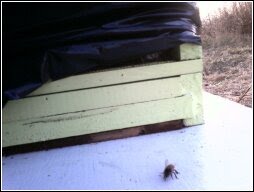
See my first bee customer? She showed up after less than 10 minutes.
I noticed that flies found the feeder within about 3 minutes. I do think flies have a more sensitive sense of smell than other insects--either that or they're more hungry! I noted that it was warm enough for other insects to be out and about.
I was very surprised to see bees from both hives bringing back pollen! They had soft yellow and darker yellow pollen attached to their back legs. Some of the bees had small lumps but others actually had some pretty decent sized lumps of pollen collected. Where on earth are they getting it from? Amazing.
This location is fantastic for the bees... and me. This photo is a bee with pollen on her legs but sorry it can't be seen - All the photos are cell phone photos because I left my digital camera at home.
I purchased bee cozies from NOD Apiaries earlier this fall. They're made with a strong black plastic with a soft polyfill sealed inside. It's basically a big tube that you push down over top of the hive and it acts just like a nice big warm quilt over the hive.

They will cut down significantly on drafts and cold winds and they'll help the hives retain more of their heat. The black plastic also attracts the sun and helps to warm the hive.

It's designed to have a "peak" in the front center of the hive that sticks out and that's where the bees can come and go from the hive. Rain or snow can channel down this section with no problems.

These cozies must be used with top exits in addition to the reduced entrance at the bottom. The top exit provides needed ventilation so water droplets don't form inside the inner cover and drip down on the bees.

You can see a U-Tube video demonstrating the cozies being put in place.

On the advice of the beekeepers, I left the styrofoam feeder as an insulator for the hive. They suggested filling it with leaves but I had a couple old pollyfill pillows so I put them inside a plastic bag inside the feeder. So the bees can't access it, but it's there as top insulation.

I do hope that the bees are snug as a bug in a rug this winter.
NOTE: Visited 2 days later and found about 100 bees dead in front of Hive #2 - bees with pollen on their legs. I put the covers on at 4:00 that afternoon, with dark coming around 5:00. It appears that these bees must have still been out foraging and couldn't find their way in. They didn't recognize the change and then the cold air probably did the rest. I suggest installing either early in the morning or after dark.

Saturday, November 21, 2009

2009 Annual Beekeepers' Convention Niagara Falls Ontario

This year I only attended day one of the two day conference and it was a really worthwhile. In fact, I regret that I didn't stay over night and attend both days because there was some really great information shared. This year it was held at the Hilton Falls View Hotel in Niagara Falls, Ontario. (It's a great hotel by the way).

Also, the chance just to chat and network with other experienced beekeepers proved to make the trip worthwhile. Two other people, and myself found just the chance to network with others to be worth the trip alone.

One person was able to make a great business deal by chatting another beekeeper, another learned a unique way to make a mouse guard that stays attached to the hive and then just slides up and down. And me, I was able to get questions answered on approaches for winterizing my hives which I was considering and I found out I was on the right track with my ideas which is always a relief. Of course I learned some new things (I'll blog on those soon).


A report from the meeting which I must share is on a new Formic Acid Flash Gel treatment that will be available soon. This Varroa Mite treatment was tested by our Ontario Bee Association Tech Team with great results.

The formic acid gel was put into hives this fall and their reports are that kill rates of Varroa Mites was 98%. But here's the great part - it did it in 3 days! This treatment is so effective it only needs to be on the hives for a very short time.

Just think how easy it will be to do a summer treatment between nectar flows to knock down mite counts if they're getting high.

I asked what the difference was between, for example, the Mite Away II pads of formic acid (see my blog of 30 Oct 2009 for details) and this new Formic Acid Gel.

The Mite Away II Formic Pads are designed to rely on ambient temperature in order to fumigate the hive whereas the Formic gel uses heat from the cluster as its Method of Delivery.

Apiguard gel was discussed - in the USA they were able to get 91% control but in Canada with our cooler climate we were only able to obtain a 70% control so it has not been as effective as a treatment here.

This new gel treatment called a Formic Acid Flash treatment will be available soon from NOD Apiaries in Ontario.


Dr. Ernesto Guzman and his team at the University of Guelph have been busy working on an improved method of delivery for Thymol treatments. Apparently, treating with Thymol is not new (I think the brand name was Apistan - but I'm not certain) and it has also been used previously as a powdered sugar. These other treatments were not as effective with their kill rates in Canada and testing at that time only produced 70% kill rates.

With a change in the method of delivery (which patent could be pending --this has yet to be worked out by the University of Guelph) they were able to get between 90 to 98% control over Varroa. It is hoped we'll see this Thymol treatment on the market in the future.

I noticed a theme for the day was very much on improving existing systems by simply changing the method of delivery.

I'll blog more on the conference when I dig into my notes. I have info to share on the use of ozone to kill spores and bacteria as well.

Beekeeper Mail

To the Grade 1 and 2 classes and Mrs. Bennett's grade 2 & 3 class:

Thank you so very much for your letters about beekeeping and honey bees.

I really enjoyed reading them and I was very impressed with your letter writing.

You were all listening very well and I'm glad that you learned a lot more about honey bees.

I had a lot of fun visiting your school and talking about my favourite subject.

(Can you guess what my favourite subject is?....... Yes, it's honey bees!!!)

Next time I come to visit I hope to bring some bees to show you but don't worry, the bees will be in a special cage behind glass so they won't hurt you.

It was fun buzzing like bees and trying on the bee suits.

Soon it will snow and the bees will hibernate for the winter. Then in spring when it gets warmer they will fly out in search of nectar and pollen for their hive to feed to their brother and sister bees.

I hope you will enjoy seeing bees in the garden and the taste of honey on your toast. It's so yummy!

Sincerely,

Barbara Beekeeper

P.S. I forgot to tell you in my talk that honey bees can count! They can count all the way up to 4. Not bad for a 'stupid insect' eh? If you are wondering how they count, they use visual landmarks to find their home. So a tree and a bush and a flower and a rock would be 4 things the bee would remember when she's looking for her home. They use smell too but just like humans they rely on things they can see too to find their way around.

Wednesday, November 11, 2009

Cute as a Puppy?

My beekeeping friend Mark took this awesome bee photo and I used it in a PowerPoint presentation that I created.

Ever since seeing fuzzy bees under a microscope I was impressed how much--to my mind--they looked like small puppies. So I'm on a mission to convince everyone else how cute they are, especially people who maybe don't like bees very much.

Some of you beekeepers out there reading this blog might have already received the phone call... you know the one that says "I'm a teacher from such-and-such a school and my classroom is doing a module on honey bees." Or you might get the call I got, "The kids at school are being stung by yellow jackets and their fear of bees is really escalating. Can you come and talk to them about honey bees?"

Well, I can't say no to an opportunity to educate young people about bees. Actually, it's kind of a dream of mine to have my children's novel published and then travel all over the place talking to classrooms of kids about honey bees.... yeah, I'm kind of weird ;)

I made a PowerPoint presentation which you can view or copy from my website under the teachers' link called honeybees.ppt. I've tried to make the presentation interactive since everyone learns so much better that way and it's not so boring as just straight lecturing. Feel free to use it if you like - or be inspired by it when creating your own. If you do use it, let me know how it went. You'll need Microsoft PowerPoint (version 2003 or later) to view it.

I'll probably make slight changes as I go along and upload the updates. I've presented it about 3 times today to classes of kids from JK to grade 5 and it went really well. I also took in an empty hive and then dressed the kids up in bee gear (no problem getting volunteers for that!). I had the JK's buzz like bees when we opened the hive and instructed others to say "puff, puff" when I held the smoker and said "smoke". They were most cooperative and there were so many questions that I never did actually get through the whole presentation.

But it's not the goal to get through every slide. The slides are great to give a visual, to provoke questions or peak their interest. I've learned with teaching over the years that it's much more productive to answer questions when asked (a true learning moment) than to just focus on getting through all the material.

I don't have an observation hive yet so no live bees went on this trip. It's fall now too and much too cold to open the hive and remove frames. What I did do though was print colour photos of bees which I taped into frames and they looked very real. After dressing the kids up I pretended to do an inspection, having one child hold the smoker and I used the hive tool.

I also took in little samples for show and tell: Wax scales and pollen that I picked up off my sticky board and a few pieces of wild comb and propolis for them to see.

It was a real blast and I look forward to more opportunities to do this in future.

Friday, October 30, 2009

The Formic Acid Pad - Mite Away II Pads

I didn't measure with a ruler but the pad is about 6 or 7" square.

They were Mite Away pads of Formic Acid that came pre-soaked they really did smell strong.

Formic Acid creates fumes strong enough to kill Varroa Mites and to penetrate capped cells as the mites feed off baby bees in their cells.
The pads have 250 ml of 65 % formic acid in them. Its the combination of this and the holes in the bag, the front of the hive open and the bees ventilation along with temps of + 10 Celsius that makes it a successful treatment.

The small Mite Away pads have 35 ml of 65% formic in them x 6 or 7 applications 4 to 7 days apart to give the same result as the larger pads. The large pads which I used are left in the hive for a full brood cycle - between 24 to 26 days.

The pads work by fumigating the hive to a point where it doesn't kill the bees but makes the mites let go of the bees. The heaviest concentration of acid fumes are on the floor of the hive where it kills the mites.

Regular garbage is fine for disposal of the pads after treatment. Most of the acid will have evaporated and formic is a natural acid.

When the pads were first taken out of the barrel at the bee supplier's place, we didn't want to be close to it because the smell is quite pungent. Yes, it smells like super strong so don't inhale it. It reminded me a bit of the occasional time I get a little too much pickle juice and then I choke or cough.

The pads sat on the small sticks laid across the top bars of the hive. A rim spacer was in place to create a little space for the pad as well.

It comes with the pre-made holes on one side - the bottom and the holes are to face down. The fumes from the pad will drop down into the hive and then be ventilated by the bees.

My hives are not 2 deep hive bodies. Instead I am running 1 deep and 1 medium.

The pads cannot be held with bare fingers or they will burn your skin. I purchased a pair of special plastic chemical gloves to hold the pads with. Later I found chopsticks more effective to pick up or shift the pad without touching it.
If the weather doesn't cooperate and it's too late to do a Formic Acid treatment, there is Oxyalic Acid which can be put in the hive in the middle of winter. It's done with a drip syringe.

Patty Cake, Sugar Cake, Yummy said the Bees

I really never liked cooking. So this recipe is perfect for me. It's a no cook sugar patty recipe.

After reading around the web a bit about fall feeding I decided to add some kind of feeding in addition to the sugar syrup. The weather had been cold at night and the bees were really only eating the syrup on warmer days.
I got "fine sugar" which is caster sugar in the baking aisle at the grocery store. Caster sugar is regular white cane sugar but it's ground up into a fine powder-like consistency. I remember many, many years ago making caster sugar in cooking class at school by putting regular sugar into an electric grinder. It's used a lot to sprinkle on top of fruit or fancy desserts. Icing sugar isn't really the best for feeding because it contains corn starch which the bees don't really digest very well.
I used sugar syrup as a liquid to pour into the caster sugar bit by bit. You have to start small because the sugar can get too running if too much liquid is added. I made it into a moist consistency of thick paste.

I laid strips of wax paper on the top bars of the hive and spooned the mixture onto the paper. (At a later feeding I did all the spooning onto the paper before opening the hive so it was ready to set right in - reducing the amount of time the hive was open in the cooler weather). I suppose I could have got my hands dirty too and formed them into patties like hamburgers.

I also sprinkled just the plain caster powder on another strip of wax paper.

I returned today (5 days later) to find that the bees in both hives had gobbled up both the sugar cakes and the powder sugar. They were swarmed all over the paper and I had to shake them off.

In Hive #1 they had chewed up the paper and later I watched as bees left the hive carrying out bits of the white wax paper - cleaning house.

They hadn't taken much of the sugar syrup. Hive #2 had lots of bees under the clear panel in the hive top feeder but I didn't see any in Hive #1. It was concerning at first for Hive #1 until I removed the feeder and saw the top bars covered in bees licking up the sugar cake.

So, I made up a fresh batch and left it for them. Bon appetite!